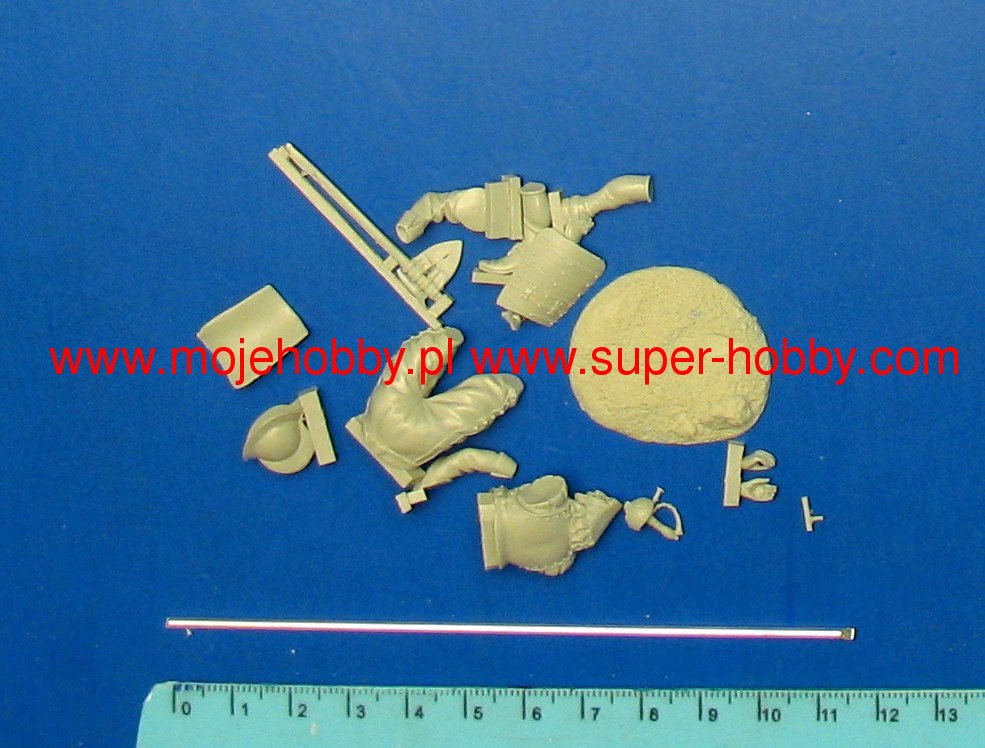
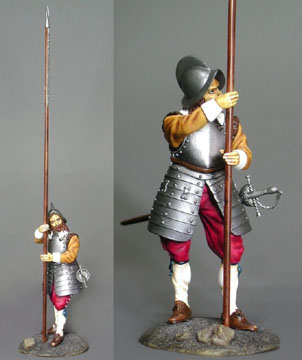
It is assumed that the first units of pikemen appeared in Swiss troops in the late Middle Ages. Despite the development of firearms, they did not disappear from the battlefields in the 16th century and played an important role in infantry tactics until the end of the 17th century. Generally, it can be assumed that the main weapon of pikemen was a pique, i.e. a gun with a spear tip with a total length of 2.5 to 5.5 meters. As a side weapon in the 17th century, the most common was the rapier, much less the pistol. The defensive armament was a characteristic helmet called a morion and a cuirass. Very often, trunks and shoulder pads were used for it. It happened, especially in the final stage of the Thirty Years' War (1618-1648), that instead of cuirass, pikemen used a colet, i.e. a specific armor made of properly prepared leather. At the beginning of the 17th century, especially in the Dutch art of war, pikemen were a strictly defensive formation, which was to provide protection to their own musketeers. The Swedish king Gustav II Adolf, who emphasized their close cooperation with the musketeers, also in offensive activities, changed the role of pikemen on the battlefield, based on the Dutch solutions. Pikemen units disappeared from the battlefields of Europe at the turn of the 17th and 18th centuries, along with the widespread use of flintlock firearms and bayonet.

 Обязательно посетите этот сайт, там найдется много всего интересного.