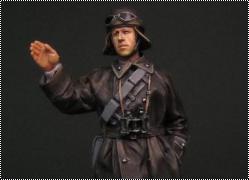
At the outbreak of World War II, the British Army had only two Armored Division: the Mobile Division and the Egyptian Mobile Division. In 1939-1940 they were transformed into the 1st and 7th Panzer Divisions. In the course of the war, another 9 armored divisions were formed, but not all of them entered action, and some of them did not go beyond the stage of formation and training. In 1940, the position of the British armored division envisaged two tank brigades, which included after a motorized infantry battalion, as well as numerous support units, including anti-tank artillery, field artillery, relatively numerous repair and transport units and sapper units. The division formed in this way consisted of about 220 tanks of various types. However, in 1944, the structure of the British armored division changed based on the experience of the fighting in North Africa and Normandy. The post from 1944 provided for the deployment of one armored brigade with three armored regiments of 78 tanks each ((total - 234 tanks), a motorized (de facto mechanized) infantry brigade with three battalions and relatively strong field artillery and support units - between It is worth adding that in the declining period of World War II, the British Armored Divisions were mainly equipped with Sherman tanks (also in the Firefly version), A34 Comet or the light M5 Stuart.During World War II, the British Army formed a total of 43 infantry divisions. At the start of the war, the division's staff numbered approximately 13,800 officers and soldiers, while in 1944 this number increased to approximately 18,300 people. This significant change in the number of employees resulted primarily from the increase in various types of support units, and not the increase in the number of infantrymen themselves. In 1944, the British infantry division consisted of three infantry brigades, each with its own headquarters, a staff platoon, 3 infantry battalions, and engineering divisions. It is worth adding that a single infantry battalion had approx. 780 officers and soldiers and had numerous support units (e.g. a mortar platoon or a reconnaissance platoon). The division also included a de facto artillery brigade with five artillery regiments (including one anti-tank and one AA), a battalion of machine guns and mortars, as well as reconnaissance, communication and sapper units. An important element increasing the mobility of the British infantry division was its full motorization. The British infantryman's primary rifle was the Lee Enfield No.1 or No.4 rifle. As machine weapons, among others, Sten submachine guns, Bren manual machine guns and Vickers machine guns were used. The most commonly used anti-tank weapons were the 40 and 57 mm 2- and 6-pounder cannons, and later also the 76-mm 17-pounder cannons. In turn, the main armament of the field artillery was a very successful howitzer Ordnance QF 25-pounder.

 Обязательно посетите этот сайт, там найдется много всего интересного.