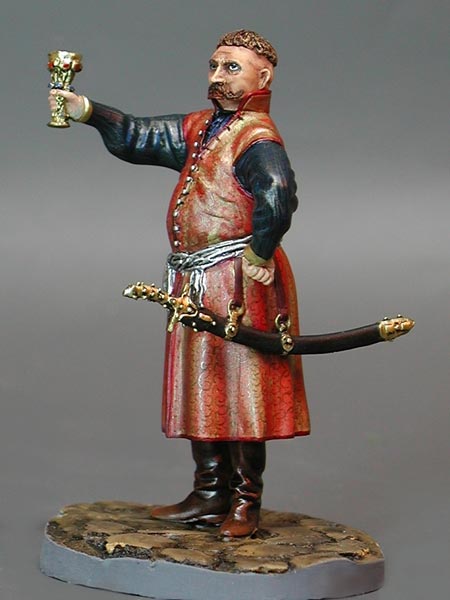
The Polish nobility is a social status that developed in the late Middle Ages (end of the 14th century and 15th century) from the knighthood. This state played a dominant role in the history of the Kingdom of Poland and (from 1569) in the history of the Polish-Lithuanian Commonwealth. It was formally and legally abolished only in 1921 under the March constitution. The nobility in the late Middle Ages, by way of general privileges, received numerous and significant legal and economic advantages, which favored it over the rest of society - especially the bourgeoisie. They include, for example, property and personal inviolability, a monopoly on the purchase of goods or numerous tax and customs exemptions. In the course of the modern era (16th-18th centuries), it was the nobility who in essence decided the face of the Polish state, and later the Polish-Lithuanian Commonwealth, by participating in sejmiks and general assemblies. From 1573, the nobility also chose the Polish monarch through the election of the viritim. The Polish nobility itself, although subject to the same law, was clearly diversified in terms of property. The richest noblemen were magnates (sometimes called crimson), who often owned several dozen or hundreds of villages, and thousands of people worked on their property. Most often, it was the magnates who sat in the senate during the session of the general parliament. Very often - especially in the middle of the 16th century - the middle nobility was in a political conflict with the magnates. At the very bottom of the social structure of the Polish nobility there was the gray nobility, among which there were also farm and parochial nobility. It is worth adding that only members of the noble class - from the first half of the 15th century - could also hold the highest offices in the Polish Church. At the end of the 16th century, a belief developed - incorrect in essence - that the Polish nobility descended from the Sarmatian tribe, and this belief, after adding numerous other clarifications, became known as Sarmatism.

 Обязательно посетите этот сайт, там найдется много всего интересного.